


How long does a roof inspection take? A typical residential roof inspection in Colorado Springs takes 1 to 2 hours, while commercial and multi-family roofs often need 2 to 4 hours or more depending on size and complexity. If you’ve just noticed hail bruising, granule loss, or lifted shingles after a Front Range storm, that time frame usually determines whether you can plan around lunch or need to block out most of the morning.
Many homeowners ask this right after a storm because they’re trying to balance work, kids, and the uncertainty of roof damage. The answer is that how long does a roof inspection take depends on what the inspector has to document, not just how long they’re on the shingles. Understanding how long does a roof inspection take in different situations helps homeowners schedule their appointments and avoid unexpected delays.
What to Expect When Scheduling a Roof Inspection
A Colorado Springs homeowner staring at fresh hail marks after a spring storm usually wants one thing first, a realistic time commitment. For a typical home, how long does a roof inspection take usually lands in the 1 to 2 hour range, while commercial and multi-family roofs often take 2 to 4 hours or more because the job is more complex and the surface area is larger. Broader industry guidance on roof inspection timing guidance puts a residential roof inspection in the 45 minutes to 3 hours range, with most standard homes closer to the middle.
The mistake is assuming every inspection is a quick walk on the roof. A ground-only look can be fast, but it usually does not produce the documentation homeowners need after hail, wind, or freeze-thaw damage on the Front Range. A defensible visit includes surface review, attic verification, photos, and a report conversation, so the appointment takes longer than a simple visual check.
Practical rule: If you need insurance-ready documentation, plan for more than a casual look. The extra time is where the evidence gets collected.
That difference matters if you are coordinating with an adjuster, a tenant, or a property manager. If you’re wondering how long does a roof inspection take after severe weather, expect additional time for photographs, damage assessments, and documentation.
Inspection Timelines by Roof Size and Property Type
When determining how long does a roof inspection take, the property’s square footage, roof pitch, and architectural complexity are among the biggest factors. A small single-story home can often be checked quickly, while a steep roof with multiple planes, dormers, skylights, and tricky flashing takes longer because each feature needs its own look. If you are trying to estimate the appointment window, it helps to calculate square footage first so you can sort the roof into a compact, average, or larger category.
| Roof Inspection Duration by Property Type | Roof Size | Typical Duration |
|---|---|---|
| Small single-story home | Under 1,500 square feet | 30 to 60 minutes |
| Average residential home | 1,500 to 2,500 square feet | 1 to 2 hours |
| Large or multi-story residence | Larger, more complex layouts | Up to 3 hours |
| Commercial or multi-family flat roof | Low-slope or expansive systems | 2 to 4 hours or longer |
Commercial roofs take longer because the inspector is doing more than a quick material check. Drainage has to be mapped, seams need to be examined, and larger roof areas often hide subtle leaks or ponding that are easy to miss from the ground. On low-slope systems, one missed seam can turn into a bigger repair later, so facility managers should expect a different timeline than a single-family homeowner.
Access also changes the clock. Multi-family properties often require coordination with tenants, building staff, or property managers before the roof work starts, and that can add real minutes before anyone even steps onto the roof. On commercial properties, a careful inspection may also include drone passes for hard-to-reach sections and infrared scanning when a hidden moisture pattern needs confirmation. Those methods do not replace hands-on inspection, but they can change how much time the visit takes and how useful the final report is.
For owners comparing service options, a detailed commercial roof inspection cost overview helps explain why time and scope rise together on larger roofs. The same is true after hail in Colorado Springs, where storm documentation needs to be specific enough for an adjuster, with clear photos of impact marks, damaged flashings, and any weather-related wear that fits the storm pattern.
Step by Step Breakdown of the Inspection Process
A thorough inspection does not spend all its time on the roof surface. In practice, the work moves from exterior review to interior verification, then into documentation and a report conversation, and each stage adds evidence that helps separate surface wear from real damage. To understand how long does a roof inspection take from start to finish, it helps to examine each stage of the inspection process.
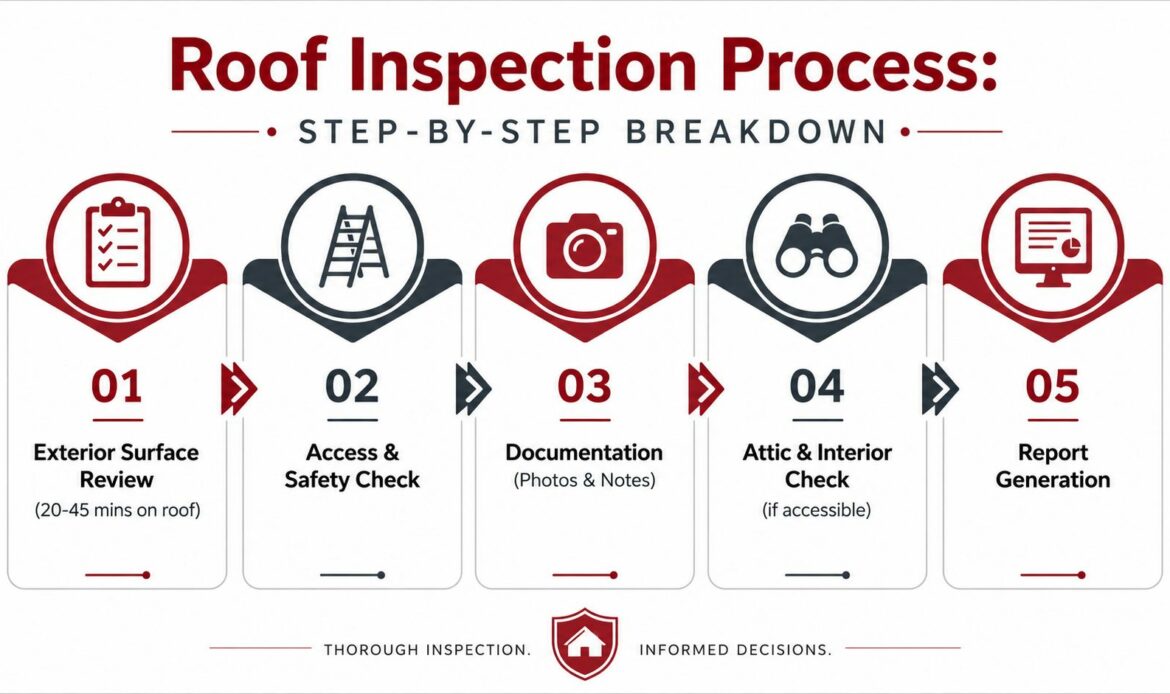
Exterior surface review
The roof walk is only one part of the job, and it commonly takes 20 to 45 minutes on its own (inspection workflow breakdown). An inspector is checking shingles, flashing, vents, penetrations, ridge lines, and any spot where hail or wind could have opened a path for water. On a storm-damaged roof, that review slows down because every bruise, lift, edge failure, and exposed nail line has to be noted and photographed.
On Colorado roofs, I also look for damage patterns that tell a clear story, not just isolated marks. Hail often hits one slope harder than another, and wind can lift the same corner of multiple shingles in a way that points to the storm direction. If the roof is steep, fragile, or too high to inspect safely by hand, drone passes may be used to document the field conditions before anyone decides whether a closer walk is safe.
Attic and interior verification
Attic work typically adds another 15 to 30 minutes when access is available (inspection workflow breakdown). That time is not wasted. It is where moisture staining, ventilation issues, and decking problems can confirm whether an exterior issue is cosmetic or active. If there is no attic access, the inspection still happens, but the report has to rely more heavily on the visible exterior evidence.
A good attic check also helps connect the roof to the rest of the house. Dark spots on the sheathing, damp insulation, or daylight at a penetration can point to a leak path that starts higher up than the stain on the ceiling suggests. In colder weather, infrared scanning can help identify temperature differences that support the moisture findings, especially when the roof itself does not show an obvious opening.
Documentation and report review
Photos, notes, and condition grading turn a roof visit into a usable record. This is the part many homeowners never see, but it is what supports maintenance planning and gives an insurance claim real structure. The roof segment inside a general home inspection can be only 20 to 40 minutes within a 2 to 4 hour total appointment, which shows why a standalone roof inspection usually takes longer than a general home inspection’s roof segment (home inspection timing).
The final report should do more than list problems. It should show where the damage is, how widespread it looks, and whether the evidence fits storm impact, wear, or a separate defect that needs repair. When the inspection is done well, the report conversation is faster because the homeowner is not trying to guess what a dark mark, lifted shingle, or cracked flashing means.
A quick look can tell you something is wrong. Documentation tells you what to do next.
How Inspection Methods Affect the Timeline
Different methods change both the length of the appointment and the quality of the output. A basic visual inspection may take 30 to 45 minutes, a standard thorough inspection usually takes 1 to 2 hours, and drone or infrared inspections can run 90 to 120 minutes when the roof is steep, tall, or unsafe to walk on (inspection methods and duration). So, how long does a roof inspection take when advanced equipment is required? The answer depends on whether the inspector uses drones, infrared imaging, or traditional hands-on methods.
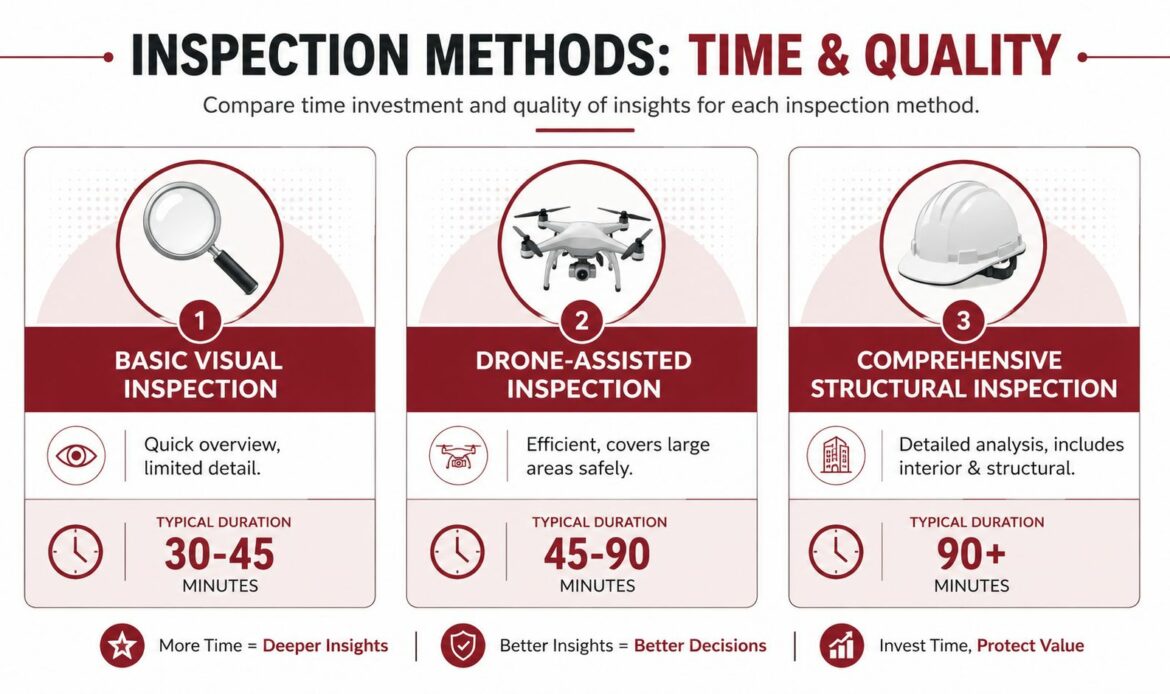
A visual check works for routine maintenance, but it won’t give you the same level of proof after hail or wind. Drone and infrared work better when the roof is too steep or too risky to access directly, and they can capture high-resolution imagery of hard-to-reach areas without forcing unnecessary foot traffic across damaged materials. For teams that want to compare operational rules around aerial work, this overview of drone laws for enterprise teams is a useful reminder that method choice also has compliance implications.
Why method choice matters in the field
An infrared scan can reveal moisture patterns that a standard walk may miss, but it also takes time to calibrate and capture properly. That’s why the timeline grows when the inspector is building a stronger record, not just checking boxes. For properties with complicated slopes or post-storm concerns, the method should match the risk, not the other way around.
If you’re comparing service formats, a dedicated drone inspection service page can help explain why aerial documentation is often the right call after a Front Range hailstorm.
Colorado Springs Factors That Extend Inspection Time
Colorado Springs roofs do not age in a neutral climate. Hail, strong wind exposure, higher-elevation UV wear, and freeze-thaw cycling all make the inspection more detailed than a generic national checklist. For local homeowners asking how long does a roof inspection take in Colorado Springs, storm severity and seasonal weather conditions can significantly affect the timeline. They are documenting impact patterns and damage clusters so the findings can hold up later with an adjuster.

Weather damage takes time to document
Hail damage documentation adds time because every impact zone needs clear photos and notes. Freeze-thaw assessment also takes longer, since cracked shingles, compromised flashing, and signs of ice damming can be subtle in the early stages. Wind exposure along the Front Range can lift edges or loosen fasteners without leaving a dramatic visual clue, so the inspector has to move carefully across the roof line.
Insurance-scope inspections often take longer than a routine maintenance visit because the evidence has to be organized, not just observed. That extra time gives the homeowner something usable when the claim process starts, and it also explains why some reports are not delivered until a day or two after the inspection, even when the on-site visit itself felt short (insurance documentation timing).
Commercial roofs need a different pace
Flat and low-slope roofs in Colorado Springs bring their own challenges. Drainage paths, seams, and wide spans take longer to review, especially when the property has tenant access, rooftop equipment, or multiple roof sections. Facility managers usually need a longer appointment window than a homeowner does, and that is normal.
On those roofs, the inspector may also need more time for drone images, moisture checks, and attic or ceiling access if the building design allows it. The pace slows again when storm damage is mixed with routine wear, because the report has to separate pre-existing issues from hail or wind damage before anyone can use it for repairs or an insurance claim.
In a storm market, the inspection timeline is really a documentation timeline.
How to Prepare for a Smooth and Efficient Inspection
Although how long does a roof inspection take depends largely on roof conditions, preparing your property ahead of time can minimize unnecessary delays. Start with access, then give the inspector the background they need to understand the roof’s history and any storm-related concerns. Clear the driveway, open gates, and keep pets indoors so the crew can move without delays.
If the attic or upper crawl space will be checked, make sure those areas are easy to reach before anyone arrives. In Colorado Springs, that matters after hail because inspectors often need to move between the roof, the attic, and the exterior to document what the storm did. The smoother the access, the more time stays focused on the roof itself.
- Clear the driveway: Give the inspector room for a vehicle, ladder, and equipment.
- Secure pets indoors: Reduce interruptions and safety risks while access points are open.
- Move vehicles away from the garage: Keep attic access and overhead entry points open.
- Gather prior documents: Previous inspections, warranty paperwork, and repair records help with context.
- Note your concerns: Point out leaks, missing shingles, stains, or wind-damaged areas right away.
Commercial property managers need one more layer of coordination. Tenants may need notice, facility staff may need to open roof hatches or mechanical rooms, and those extra handoffs can slow the appointment if no one is ready. For a practical homeowner checklist, the home inspection preparation guidance from a local inspection resource can help you organize the day without overcomplicating it.
If you want a simple companion for getting the property ready, a Pine Country home inspection guide can help you line up the basics before the inspector shows up.
Frequently Asked Questions About Roof Inspections
How long does a roof inspection take for an average home? Most residential roof inspections take approximately 1 to 2 hours, although larger homes, steep roofs, and extensive storm damage may require additional time.
Do I need to be home during the inspection?
Not always, but it helps if the inspector needs interior access or you want to walk through concerns in person. For attic checks and post-storm documentation, being available can speed things up and make sure the right areas get reviewed.
How soon after a hailstorm should I schedule one?
As soon as possible. Colorado Springs storms can leave hidden damage that worsens with the next wind event or freeze-thaw cycle, and early documentation is easier to tie back to the storm that caused it.
Is a roof inspection the same as the roof portion of a general home inspection?
No. The roof portion inside a general home inspection is usually shorter, while a standalone inspection is more thorough and better suited for storm damage, maintenance planning, or insurance records.
What happens if damage is found?
The inspector should document the issue, explain the likely scope, and help you understand whether repair or claim steps make sense. If the damage is storm-related, detailed photos and notes become especially important when you speak with an adjuster.
Are commercial and multi-family roofs handled differently?
Yes. Flat and low-slope systems usually take longer because drainage, seams, and access logistics matter more. Property managers should expect more coordination and a longer on-site window than a standard home inspection.
Schedule Your Free Roof Inspection Today
If your roof took hail, wind, or freeze-thaw stress this season, don’t wait for a small issue to turn into a leak. With 250+ years of combined experience, drone assessment capability, and a 100% satisfaction guarantee, 7 Summits Roofing helps Colorado Springs homeowners and property managers get clear answers fast, with transparent communication from start to finish.
If you need a roof inspection in Colorado Springs, reach out to 7 Summits Roofing for a free inspection or quote. Their team knows Front Range hail, wind exposure, and freeze-thaw damage, and they’ll help you understand what your roof needs before the next storm season hits.