


A roof leak after a Front Range storm is the kind of problem that starts small and then steals your attention. You spot a stain on the ceiling, check the roof from the driveway, and everything looks normal, which is exactly why a professional roof leak detection service matters in Colorado Springs. Hail can bruise shingles without making an obvious hole, wind can lift flashing just enough to let water in, and freeze-thaw cycles can open cracks that only leak during the next storm.
The challenge is that water rarely shows up where it entered, which is why a professional roof leak detection service is essential for identifying hidden moisture intrusion and preventing further damage.
It can run along decking, framing, insulation, or drywall before you ever see a drip, so a patch based on the stain alone is often a guess. In a city where hail, high wind exposure, elevation-driven UV, and rapid weather swings all work against a roof, the right diagnosis saves time, money, and a lot of second-guessing.
Why a Roof Leak Detection Service Matters in Colorado Springs
A homeowner calls after a spring hailstorm, says the ceiling stain showed up in the dining room, and insists the roof looks fine from the ground. That’s a common Colorado Springs story, and it’s why a quick visual check isn’t the same thing as real diagnosis. The roof may have taken impact without immediate failure, then started leaking days later when the next wind-driven rain hit the weak point.
Front Range weather makes small damage act bigger
Hail can bruise shingles, weaken seals, and leave the roof vulnerable even when nothing is missing. Wind exposure can bend flashing around vents, chimneys, and roof edges, while freeze-thaw cycles keep working small cracks wider. Add stronger UV at elevation, and roofing materials age faster than many owners expect, especially on older asphalt systems.
Water intrusion is also deceptive. A professional roof leak detection service can help identify moisture entering at a ridge, valley, or flashing detail before it travels across the assembly and appears inside a room. That’s why a ceiling stain doesn’t automatically point to the hole in the roof.
Practical rule: if the stain is indoors but the roof looks intact from the driveway, don’t assume the visible spot tells the whole story.
The diagnostic gap matters even more on homes with other possible water entry points. A leak near a wall can come from the roof, but it can also involve windows, siding, or flashing at an intersection. If you’re comparing roof symptoms with other envelope issues, a related local resource like commercial window service Colorado Springs can help homeowners think about the whole exterior system instead of blaming every stain on the shingles.
A storm-damaged roof that goes unchecked can turn a minor leak into insulation damage, mold growth, and interior repairs that have nothing to do with the first symptom. For Colorado Springs homeowners, the point isn’t panic, it’s speed and accuracy. A professional roof leak detection service provides a targeted inspection that identifies the source before water damage has time to spread.
For a closer look at local conditions that affect roofing, see Colorado Springs roofing challenges.
Common Signs Your Roof Has a Leak
The easiest leaks to spot are the ones that already left a stain. The harder ones show up as subtle changes, an odor, a soft spot, or a damp patch that appears only after a specific wind direction or rapid snowmelt. In Colorado Springs, that kind of intermittent behavior is common enough that scheduling a roof leak detection service is often the most reliable way to identify the underlying problem.
Inside the building
Ceiling discoloration usually appears first, but it’s not the only clue. Wall staining near rooflines, peeling paint at upper corners, and a musty attic odor often show up before a drip ever reaches drywall. Wet insulation is another red flag, because once insulation gets saturated, it stops doing its job and keeps hiding the problem.
If you can safely access the attic, look for dark trails on framing, compressed insulation, or wood that feels damp to the touch. Those clues help narrow the search area, but a professional roof leak detection service may still be necessary to determine whether the roof breach is directly above them. Water can move laterally before it settles.
Outside the house
On the roof, missing shingles are obvious, but cracked or lifted flashing around chimneys, skylights, plumbing vents, and wall ties is often more telling. Clogged gutters and backed-up downspouts can force water where it shouldn’t go, especially during heavy runoff or snowmelt. Granules collecting in gutters or downspouts suggest shingle wear, which matters more after hail.
Ice dams are a separate winter clue. When snow melts and refreezes at the eaves, water can back up under shingles and reveal weak spots that stayed hidden in warmer weather. That doesn’t mean the roof is failing everywhere, it means the vulnerable area may only leak under specific conditions.
For homeowners who want to compare professional methods with a broader consumer overview, tools to detect roof leaks offers a useful perspective on the range of equipment that can be involved.
The big takeaway is simple. A leak that appears only during wind-driven rain from one direction, or only during fast thaw cycles, usually needs a methodical inspection. Guessing from one symptom rarely solves it.
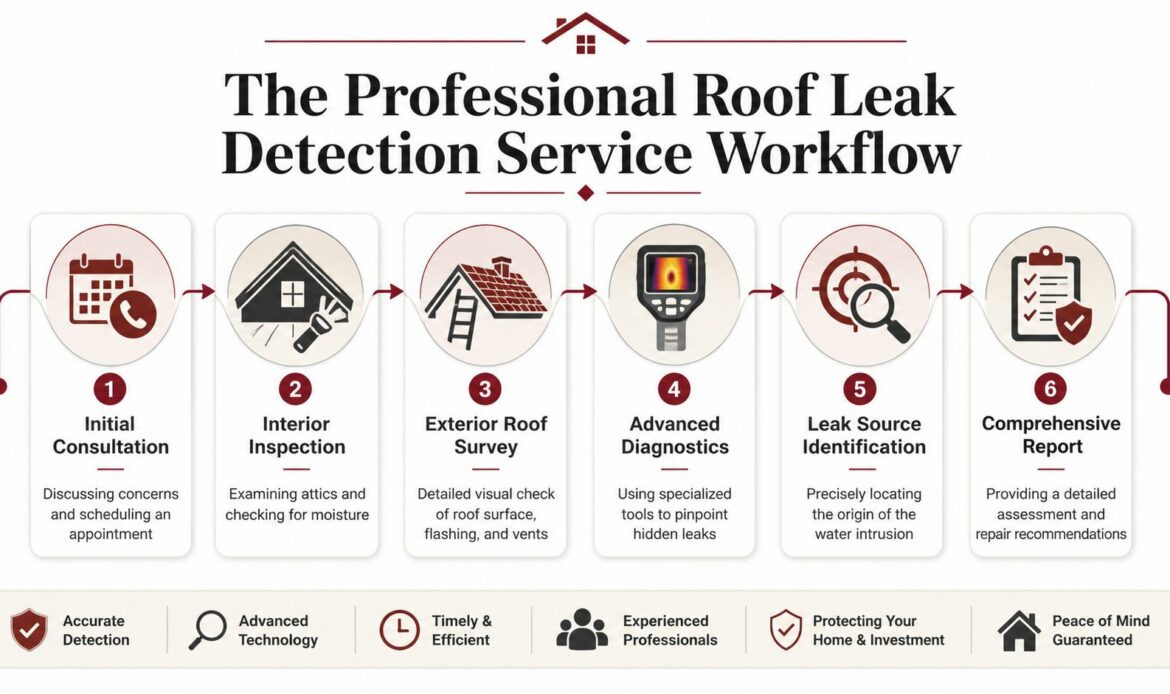
The Professional Roof Leak Detection Service Workflow
A solid roof leak detection service doesn’t start with a ladder and a flashlight. It starts with narrowing the problem, because a stain, a damp attic bay, and a missing shingle are all clues, but they’re not the same clue. Understanding how a roof leak detection service works matters because each stage of the process eliminates uncertainty and helps technicians identify the actual source of water intrusion.
Interior first, then the roof
A professional roof leak detection service typically begins with an inspection of the attic or upper interior space, where technicians look for evidence of moisture intrusion.
A technician looks for moisture trails, insulation compression, fasteners with rust, and staining patterns on framing members. Those details show where water has been traveling and help define a likely entry zone before anyone steps onto the roof.
Then comes the exterior survey. The technician reviews shingles or membrane condition, flashing, penetrations, parapet details where present, valleys, and drainage points. On many roofs, the first priority is not the field of shingles, it’s the areas where water is supposed to be controlled.
Best practice: the repair target should come from a pattern, not from the most visible damage.
Controlled water testing comes next when the source still isn’t clear. Small roof sections are wetted in sequence while someone below watches for the first sign of intrusion, which helps separate the actual entry point from the place where the water finally appears. That method is slower than a visual guess, but it is much more reliable when leaks are intermittent.
Documentation is the final step, and it’s not paperwork for paperwork’s sake. Photos, notes, measurements, and moisture findings help support repair planning and insurance conversations. If the leak turns out to need a targeted repair rather than a broad tear-off, that record helps everyone understand why.
That structure is why a professional inspection usually costs less in the long run than a misdiagnosed patch. For a general sense of typical inspection pricing, a professional roof leak inspection commonly falls in the $150 to $400 range, with simpler visual inspections around $150 to $250 and more detailed inspections around $250 to $400 according to the NRCIA roof leak inspection service guidance.
Advanced Technology Used in a Roof Leak Detection Service
Advanced tools can make a roof leak detection service more effective, but only when the roofing problem requires specialized equipment. The best inspectors match the method to the roof type, the accessibility, and the symptom pattern instead of reaching for expensive equipment too early. That’s especially true on Colorado Springs roofs where a leak may be hidden, intermittent, or spread through multiple layers.

What each tool does well
Infrared thermography is valuable because it can reveal temperature differences caused by moisture, especially in wet insulation or hidden areas under the roof surface. It helps map suspect zones, but it doesn’t pinpoint the exact hole by itself.
Electronic leak detection, or ELD, is the precision tool for membrane breaches. Industry guidance explains that low-voltage wet testing uses a conductive field on a wetted roof surface, while high-voltage dry testing is used on dry exposed membranes to find pinholes and punctures on suitable assemblies. The point is specific location, not just suspicion.
Moisture meters and capacitance scanning help confirm where moisture is present and how far it spreads. That makes them useful for deciding whether the problem is isolated or broad enough to require a larger repair area.
Good sequencing matters: map the moisture first, then pinpoint the breach, then decide how much roof actually needs work.
Where the tools fit on local roofs
On flat and low-slope roofs, ELD is often the most direct way to identify membrane failure. On steep residential roofs, the problem may be better served by attic review, exterior survey, and controlled water testing first. On taller commercial buildings or roofs with hard-to-reach areas, drone surveys can help document surface conditions without turning the first visit into a risky climb.
No single tool solves every leak. Moisture surveys tell you where water is. ELD tells you where the membrane failed. Controlled testing tells you whether the entry point is really the roof or something else entirely.
For aerial review on difficult roofs, drone inspections can be part of a broader diagnostic plan when access or safety limits a hands-on inspection.
DIY Checks Versus a Professional Roof Leak Detection Service
A homeowner can do a lot before calling for service, and those first checks are smart. The mistake is thinking those checks can replace trained diagnosis, especially after hail or wind exposure when damage isn’t always visible from the ground. In practice, DIY tells you whether there’s a problem, while a professional inspection tells you where it starts.

What you can safely check
A ground-level look with binoculars can reveal lifted shingles, missing ridge pieces, or obvious flashing issues. Inside the attic, a flashlight helps you spot staining, wet insulation, or daylight coming through a hole. Clearing gutters and downspouts is also worth doing, because drainage backups can mimic a roof leak or make one worse.
Accessible flashing around vents and chimneys deserves attention too. If the sealant is cracked, the metal is bent, or debris is packed around the penetration, that’s a strong reason to call someone in. These are useful homeowner checks because they’re safe, fast, and give context before a technician arrives.
Where DIY stops working
Steep roofs, hail-damaged surfaces, and any roof that’s wet or icy are bad places for a homeowner to climb. DIY also can’t do controlled water testing, thermal imaging, or moisture mapping, which means you can’t trace a leak that appears in one room but originates elsewhere. Intermittent leaks are the worst offenders, because they often appear to be fixed until the next weather change proves they weren’t.
Rule of thumb: if the leak source isn’t obvious within a quick interior and exterior check, bring in a pro before you start opening walls or replacing unrelated materials.
That’s especially important for multi-story homes, flat roofs, and low-slope systems, where access and water movement make misdiagnosis more likely. In those situations, professional inspection cost is modest compared with the cost of repairing the wrong area twice. A professional roof leak detection service can help prevent unnecessary tear-offs, identify the correct repair area, and protect the rest of the building from further water damage.
Navigating Insurance Claims for Roof Leaks
Insurance gets easier when the facts are organized. In Colorado, sudden storm damage from hail, wind, or a fallen tree is the kind of event homeowners typically think about first, while gradual wear and maintenance problems usually create a different conversation. That’s why documentation matters as much as the repair itself.
Start with a detailed report from a professional roof leak detection service that includes inspection photos, moisture findings, and specific areas of concern. Moisture mapping helps show where the problem extends beyond a single stain, and a repair estimate gives the adjuster a practical scope to review. If you’re comparing that process with broader claim guidance, the local overview at roof insurance claims in Colorado is a useful companion.
What adjusters need to see
Adjusters want evidence of causation, not just evidence of a stain. They also need timing, because the longer a leak sits without documentation, the harder it is to separate storm-related damage from secondary deterioration. Colorado hail claims can also involve disputes over whether damage is merely cosmetic or functional, so photos alone are rarely enough.
A clean claim file usually includes:
- Inspection photos that show roof conditions, interior impact, and any storm-related findings.
- Moisture or leak documentation that ties the interior symptom to a real source.
- Repair scope that explains what needs to be fixed and why.
Practical advice: don’t wait for a second storm to prove the first one mattered. The delay can work against you.
The best claims move quickly because the evidence is fresh and the roof hasn’t had time to get worse. Professional leak detection reports help here because they add objective detail instead of a vague “roof is leaking” note. That detail can make the difference between a straightforward claim and a long back-and-forth.
Why Choose 7 Summits Roofing for Roof Leak Detection Service
Local roof diagnosis works best when the team understands what Colorado Springs weather does to a roof over time. 7 Summits Roofing brings 250+ years of combined experience to homes, commercial buildings, and multi-family properties across the Front Range, and that experience matters when hail, high wind, freeze-thaw cycling, and UV exposure all shape how leaks behave. The team provides free roof inspections, drone assessments, licensed and certified technicians, transparent communication, and a 100% satisfaction guarantee.
The biggest advantage of a local company is judgment. A crew that works in this market every season knows where wind-driven rain tends to exploit a roof, which details fail after hail, and when a leak report should point to repair versus replacement. That kind of decision-making is especially helpful for property managers and commercial owners who need clear documentation, not just a quick patch.
A service partner also needs to understand the insurance side of the work. Roofing contractor insurance advice from My Policy Quote underscores why coverage and accountability matter for contractors working on real properties, and that mindset shows up in how a company documents the job, communicates the scope, and handles the field work. For owners, that translates into fewer surprises and cleaner follow-through.
7 Summits Roofing works across residential, commercial, and multi-family properties, including tile and other specialty systems. That breadth matters because a leak on a townhouse roof, a warehouse roof, and a single-family asphalt roof rarely needs the same diagnostic path. Local ownership also means faster response and a team that knows Colorado building conditions instead of applying a generic fix.
If you’re seeing a stain, smelling moisture in the attic, or trying to decide whether storm damage is real, don’t wait for the next rain to settle the argument. Request a free inspection from 7 Summits Roofing and get a clear diagnosis before a small leak turns into a bigger repair.
If you need a reliable roof leak detection service in Colorado Springs, 7 Summits Roofing can inspect your roof, trace the source of water intrusion, and explain whether you need a simple repair or a broader storm-related solution. If you’re in Colorado Springs or anywhere on the Front Range, visit 7 Summits Roofing to request your free roof inspection or quote today.